
Help & Advice
How to Fix Sloping Concrete Floors in Your House
Help & Advice
How to Fix Sloping Concrete Floors in Your House
If your concrete floor has started to slope to one side, or sunk visibly in one area, the slab itself is almost never the problem. The ground beneath it has dropped.
This is the practical guide. Three tests you can do at home in ten minutes, three causes worth knowing about, and what the right fix actually is — before you book anyone.
How to Tell If the Floor Is Actually Sloping
Most calls about sloping floors start with "I think it's slanting, but I'm not sure." A few quick tests at home answer that with numbers rather than guesses.
The ball test. Place a tennis ball or a marble on the floor in the centre of the room. Does it roll? If yes — and especially if it rolls in the same direction every time you put it down — the floor isn't level. The faster it rolls, the steeper the slope. The direction tells you which way the slab has tipped.
The 1-metre spirit level. Lay a 1m spirit level on the floor at several spots — centre of the room, near the walls, across doorways. A bubble that touches the side line means the floor is about 4–6mm out of level over the length of the spirit level. Useful for working out roughly how much movement you're dealing with.
The skirting check. Look at the gap between the skirting board and the floor at different points around the room. Is it consistent? If you can slide a finger under the skirting in one corner but it's flush in another, the slab has dropped relative to the wall. Run a finger along the base — if the gap widens at one end, the slab has tilted rather than sunk evenly.
A note on terminology: "sloping" and "sunken" are usually the same problem. A floor that slopes is a floor that's sunk on one side. Buildfix treats them the same way — the diagnosis just changes whether the slab needs lifting at one end or evenly across the room.
What's Causing the Slope
If two of those tests show real movement, the next question is what's moving underneath. There are three usual answers.
Reactive clay shrinking. Across Melbourne's west, Western Sydney, the ACT, and most of South East Queensland, the soil under the slab is reactive clay. It expands when wet, shrinks when dry, and over years the slab follows the soil's movement. For most suburban slab-on-ground homes, this is the answer.
Voids from washed-out fill. A leaking stormwater pipe, a broken sewer, or surface water finding its way under the slab will wash the fill out from one side. The slab drops into the void. The fix has to find and stop the water source as well — otherwise the void reopens.
Poorly compacted fill. Fill brought in to level the block before the slab was poured, compacted, signed off, and built on. Years later the soft sections settle a few extra centimetres and the slab tips on top of them. No leak. The ground just kept consolidating after the build.
Each has a different signature underground, and the right fix depends on which one is moving your floor. For the full visual breakdown of every symptom and cause, see sunken concrete slabs.
Two Ways to Fix It
There are two real options once a structural engineer has confirmed the slope.
Replace the slab. Jackhammer the existing slab out. Excavate the fill underneath. Recompact, fix any drainage, lay new reinforcement, pour fresh concrete, wait 28 days for it to cure. Done well, it works. The catch: weeks of work, the room is unusable the whole time, and the cost reflects all of it.
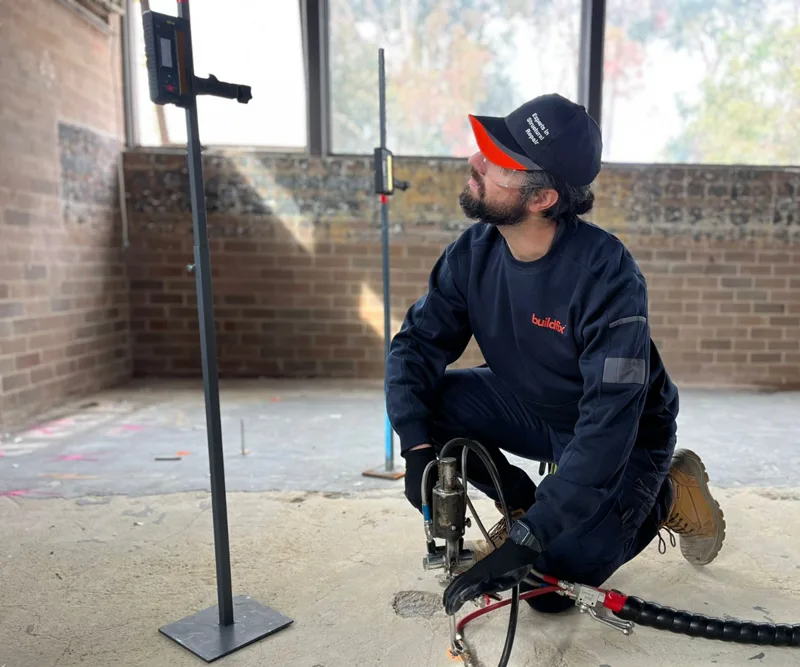
Relevel the slab in place. Drill coin-sized holes through the slab on a grid. Inject expanding resin beneath the slab through those holes. The resin compacts the loose soil, fills any voids, and lifts the slab back towards level — millimetre by millimetre — while a structural engineer watches the readings on a laser. The slab is back in use the same day. On a Buildfix job that's GeoPoly™ concrete relevelling — coin-sized holes, no demolition, most rooms done in a day. The full process is covered on the solutions page.
If the slab is structurally intact — no major cracks running through it, no large sections broken away, no rust staining from corroded reinforcement — relevelling is almost always the right call. If the slab itself has shattered or sections are gone, that's when full replacement makes sense. Every relevel is backed by a 20-year product and workmanship warranty.
When to Get the Floor Checked
If a ball rolls across the floor consistently, if a door has started catching, or if you can see a noticeable dip near a wall or in the middle of a room — that's the assessment to book. It's a 30-minute visit. A structural engineer laser-maps the floor, identifies the cause, and you walk away with a fixed-price quote on the spot. It's free.
For nearly 15 years Buildfix has been relevelling sloping floors on more than 15,000 homes and structures across NSW, VIC, QLD and the ACT. Most sloping floors don't need replacing. They just need the ground put back under them.
Call 1300 854 115 or book a free on-site assessment.
Share this article
Related Articles
Relevel Your Driveway — Don't Replace It
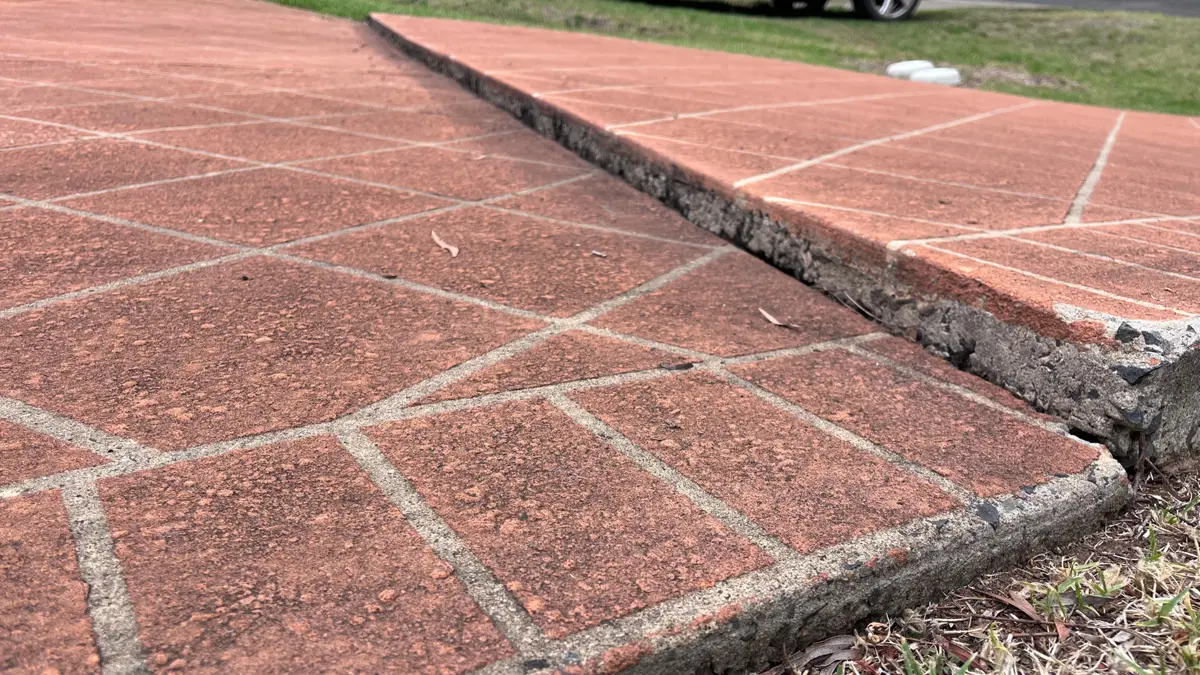
Nine times out of ten, the slab isn't the problem. The concrete is fine. The ground underneath it has dropped.
Read More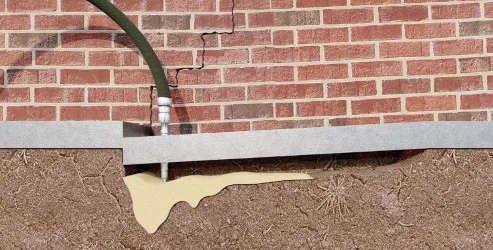
When Does a Concrete Driveway Need Replacing?
Your concrete driveway takes a battering on a daily basis. You drive your vehicle over it.
Read More
Need expert advice on your home?
Our team of engineers and technicians are ready to help.
Book a free structural assessment today.